
Architectural Breakdown: Looking for a complete tour of all flags, UI views, and setup commands? Explore the full Project2Markdown overview.
Repomix is a popular open-source tool built to pack software repositories into a single file for AI analysis. Developed in TypeScript for the Node.js ecosystem, it works seamlessly on standard JavaScript and web applications. However, when handling enterprise monorepos, multi-gigabyte game projects, or massive non-JS backends, Node’s V8 memory runtime and in-memory buffering model can encounter memory and execution limits.
Project2Markdown (P2M) was engineered in Go to solve these exact constraints. By pairing multi-threaded parallel streaming with an integrated two-way restoration pipeline, P2M serves as a lightweight, high-performance alternative tailored for large codebases and diverse technology stacks.
Architecture Comparison: Memory Footprint & Concurrency
The core technical difference between Repomix and Project2Markdown stems from their runtime execution models:
Repomix relies on the Node.js engine. When scanning large repositories containing thousands of source files, deep directory trees, or heavy assets, Node buffers file collections inside V8 heap memory. On very large projects, this approach can risk hitting heap allocation ceilings without explicit memory tuning.
Project2Markdown compiles into a standalone, dependency-free Go binary. It leverages a concurrent worker pool across all CPU cores, traversing directories in parallel and streaming file content with minimal memory overhead. This allows P2M to process massive repositories with predictable, low RAM usage while running at bare-metal execution speeds.
Feature Matrix: Project2Markdown vs. Repomix
| Capability | Project2Markdown (P2M) | Repomix |
|---|---|---|
| Core Runtime | ✓ Compiled Go Binary (Zero Dependencies) | Node.js / V8 Runtime |
| Installation Model | ✓ Single Executable (curl / irm / go run) | npm / npx package manager |
| Processing Model | ✓ Multi-threaded parallel worker pool | Single-threaded asynchronous I/O |
| Two-Way AI Restore | ✓ Native --restore with Path Sanitization Guard |
Manual copy-paste required |
| Embedded Web Dashboard | ✓ Built-in GUI (localhost:8989) |
CLI-only interface |
| Supported Output Formats | ✓ Markdown, Structured XML, JSON | Markdown, XML, JSON, Plain Text |
| Remote GitHub Repos | ✓ --remote owner/repo (Direct stream) |
Direct URL / repo parsing supported |
| Ignore File Engine | ✓ .gitignore + .p4ignore + .p2mignore |
.gitignore + custom config |
| Game Engine Awareness | ✓ Native UE logic filtering (.uproject, .t3d) | Manual ignore patterns required |
| Token Estimation | ✓ Lightweight BPE heuristic counter | Tiktoken library integration |
| Open Source License | ✓ MIT License | MIT License |
Visual Context Scoping: Built-in Local Dashboard
While Repomix is dedicated strictly to command-line workflows, Project2Markdown includes an embedded, dependency-free local web dashboard. Running p2m with no flags automatically starts a local interface on localhost:8989 directly from the compiled binary.
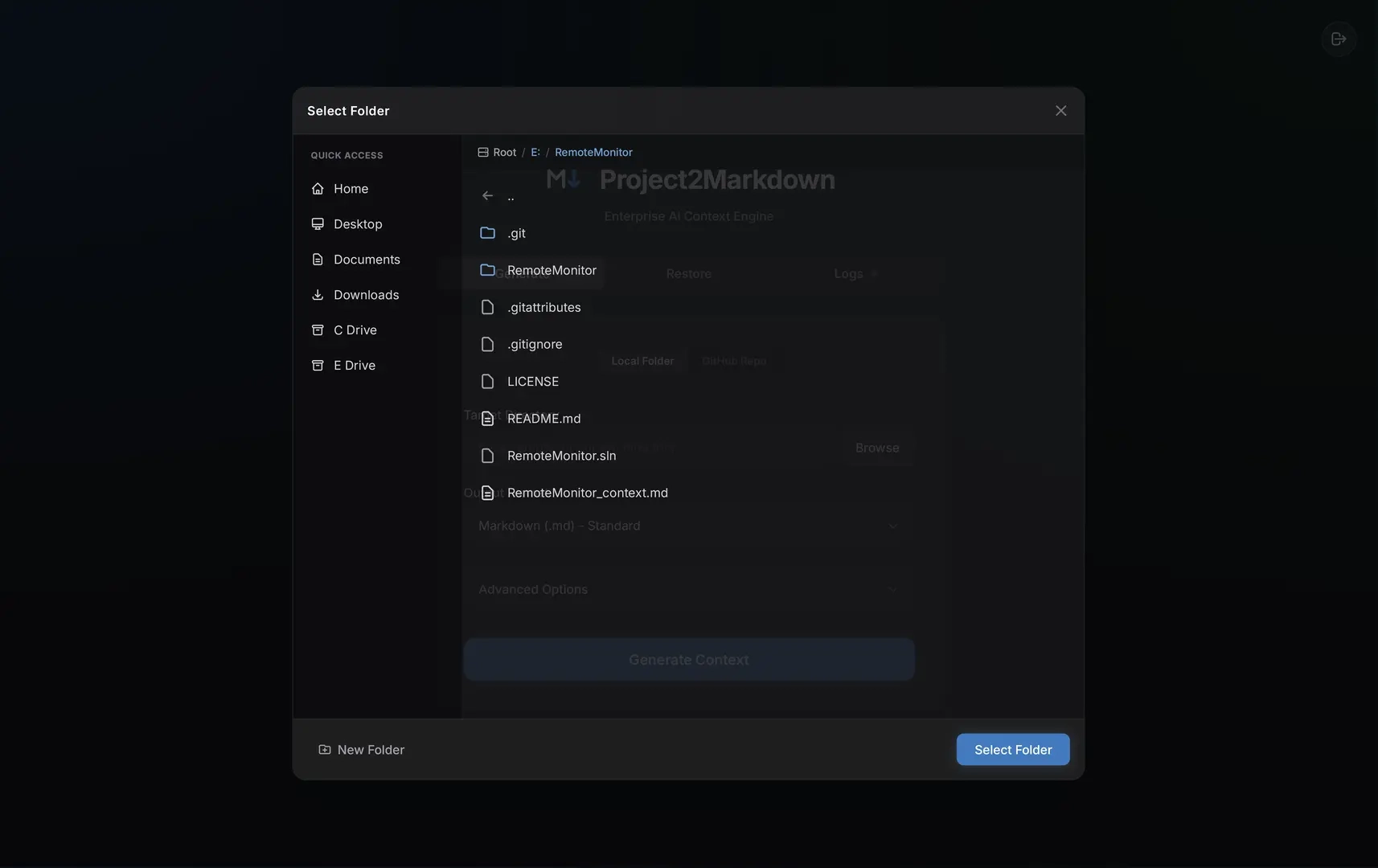
The visual interface provides real-time token budgeting, interactive file-tree scoping, and streaming worker logs. This allows developers to review exactly what files are included before copying context into frontier AI models like ChatGPT, Claude, or Gemini.
Decision Matrix: When to Use Each Tool
Choose Repomix if:
You are already working inside a Node.js/JavaScript toolchain, managing standard web repositories, and prefer executing tools via npx without managing standalone binary executables.
Choose Project2Markdown if:
You need maximum streaming speed across large codebases, require automated two-way file restoration (--restore), work in non-JS or game development stacks (C++, Go, Rust, Unreal Engine), or need a self-contained executable for clean CI/CD servers.
Migration Guide: Switching from Repomix to P2M
Migrating existing workflows from Repomix to Project2Markdown requires minimal changes. The CLI command structures map straightforwardly:
The --restore engine automatically sanitizes every relative and absolute path, rejecting directory traversal attempts (e.g. ../../etc/passwd) to protect your project directory from AI hallucinations.
Frequently Asked Questions
Is Project2Markdown faster than Repomix on large projects?
On small repositories, both utilities execute in sub-second times. On large monorepos or repositories with thousands of files, P2M’s compiled Go worker pool processes and streams files significantly faster due to multi-core concurrency and minimal RAM allocation.
Do I need Node.js or Python installed to run Project2Markdown?
No. Project2Markdown is compiled into a single static binary. It has zero runtime prerequisites and runs out-of-the-box across Windows, macOS, and Linux.
How does P2M ensure safety when restoring files from AI responses?
P2M validates and sanitizes every target path against the project root before writing, strictly blocking absolute file paths and directory traversal sequences to prevent accidental file overwrites outside your chosen workspace.
Project2Markdown Overview
Discover the architecture, token counter, and complete feature set of P2M.
Read the overview →Unreal Engine Guide
Learn how to export and minify Blueprint graphs and level logic for AI analysis.
Read the UE guide →